
In the Media
News from CSEM

CSEM research corrects myth on first time homebuyers' age.
A viral housing statistic has captured headlines and fueled frustration. But the emotionally satisfying data rests on shaky methodology, identifying the wrong problem, according to Dr. Craig Richardson, CSEM's Director.

Medicaid, health insurance in general, should be more like car insurance
Imagine you’ve just purchased a new car and it’s time to buy insurance. Luckily, you have hundreds of car insurance companies to choose from.
The power of choice means being able to investigate different policy options, customer satisfaction ratings, financial stability, and policy rates. It also means that if you’re unhappy with your company, you can easily switch to another one, especially if they have an innovative technology solution, like a cool app that lowers costs and improves service.
Photo credit: CJ photo

What if Medicaid were run more like Target?
What if state Medicaid programs were run more like an innovative, customer-friendly corporation such as Target, Inc?
Indiana’s Medicaid program is doing just that, using some novel practices that have vastly improved how people transition from Medicaid to private-sector health insurance. What’s more, it delivers better health-care outcomes at a lower cost, with some important takeaway lessons for the state of North Carolina.
Target Shopping Carts Source: Jacob Emmons, Carolina Journal

Medicaid expanded NC health-care access. But this fix could make it run smoother.
Two years ago, many low-income households in North Carolina had an unsettling fear: getting a pay raise or a promotion. In some cases, it might trigger the sudden loss of health insurance for adult family members if they were on Medicaid. This scenario was termed a “benefits cliff.”
Medical image is Creative Commons via pexels.com.

Dr. Craig Richardson publishes article on the limits of SNAP benefits in alleviating food insecurity
Titled "Why Can't Food Stamps Be Used For a Rotisserie Chicken?" at EconLog, a widely read economics website, the article details that the government SNAP program, otherwise known as food stamps, prevents people from using them on healthy hot food, but allows purchase of birthday cakes and candy. Read more on the history and the effects on healthy living.
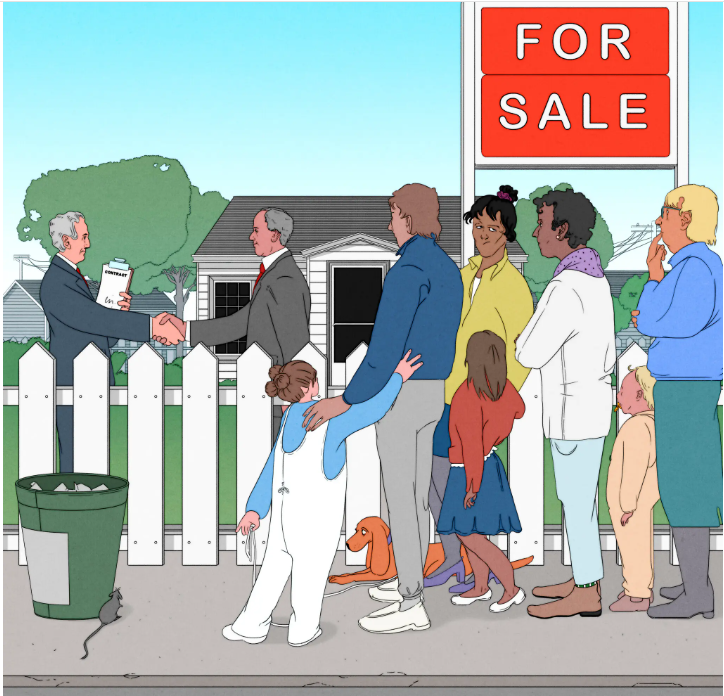
CSEM Director has article published in The New York Times on challenges facing minority/low income families in home financing
New York Times
Dr. Craig Richardson, along with his co-author Yuliya Panfil, had an op-ed published on Oct. 3rd, 2024 that highlighted how Dodd-Frank banking regulations have made it unprofitable to issue smaller mortgages that have traditionally helped Americans buy their first home and made it more difficult to buy fixer uppers. During Acting HUD Secretary Adrianne Todman's coincidental same-day campus visit, she met Dr. Richardson and noted she agreed with the article's premise and said some fixes are coming.
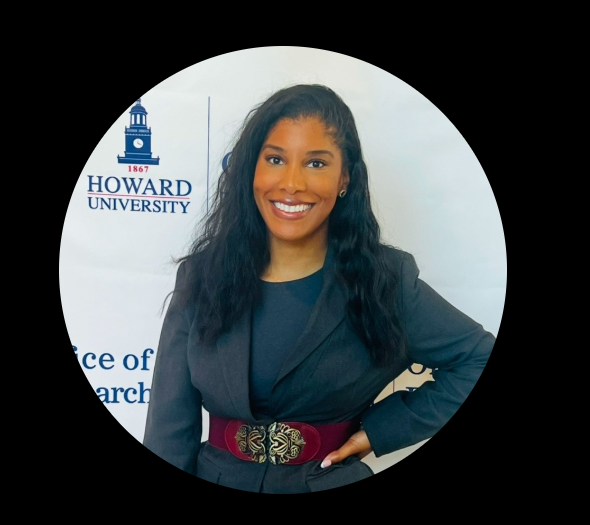
CSEM's innovative work on economic mobility profiled by national publication.
Medium, an online magazine that has a subscription base of over 1 million readers, had a recent article, "Bridging the Gap: How CSEM is Transforming Economic Mobility Through Data." Writer Isha Clayton, a graduate student at Howard University and entrepreneur, interviewed Dr. Richardson, noting that, "CSEM is at the frontline of tackling economic challenges through data-driven research and innovative initiatives." The article discussed CSEM's path-breaking data project with the City of Greensboro, its documentaries highlighting public transportation and affordable housing as well as its upcoming one on micro transit as a new means of public transportation, and how WSSU students have played a key role in CSEM's work. (Sept. 13, 2024).
Photo credit: Writer Isha Clayton, Medium magazine.
A Revolution in Public Transportation From A Town You Wouldn't Expect
American Institute for Economic Research
It’s taken more than a hundred years for low-density cities to recognize that public transportation works far better in a point-to-point model, using private-public partnerships.

Why “Disincentive Deserts” Matter Far More Than Benefits Cliffs
American Institute for Economic Research
Benefits cliffs certainly remain an important area of policy study, but we should pay more attention to creatively solving the problems of disincentive deserts, since they exist for such long and dispiriting spans of workers’ income journey, rolling back benefits at a rate that is equivalent to a 60–95% effective marginal tax rate.
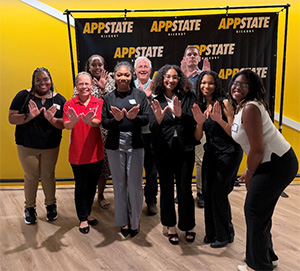
Onward and Upward: CSEM funds "Bridge to Career" event at Appalachian State University
The program offered students practical guidance for launching their careers. A Young Professionals panel of early-career CPAs and accountants shared candid insights from their experiences. Teneshia Spencer of BRC discussed strategies for securing a first job, while Mia Snipes of Martin Starnes & Associates, CPAs, P.A., offered tips for early-career success. Students then applied what they learned by completing a mini case with other event participants.
Events like this help students expand their professional networks, build confidence, and envision a clear path into the accounting profession. By removing barriers and creating opportunities, this investment brings them one step closer to careers in accounting. CSEM provides support to WSSU students wherever it can enhance upward economic mobiity.

CSEM Director's Research Hits National Audience: Affordable Housing Getting More Prominence
CSEM Director Craig J. Richardson's research with other colleagues on affordable housing is paying off: he was featured on National Public Radio's Marketplace program on June 24th, 2026 speaking about the availabilty of so called "small dollar homes" or inexpensive homes that are typically unavailable because of a shortage of small dollar mortgages. Around 1 in 4 homes (including condos) cost less than $200,000, but banks are often reluctant to finance the mortage, because small mortgages can be a money losing proposition.On July 22nd, Richardson teamed up with New America, a D.C.-based foundation, on a New America-sponsored online program, in order to examine the recent passed bi-partisan bill, The Road to Housing Act. The Act gives everyday Americans a better chance to obtain access to small dollar homes through improvements in bank financing and access. Richardson and his New America colleagues are finishing up a Housing and Urban Development (HUD) national report on how this access has substantially diminished in recent years. They addressed improvements and guided discussion with other nationally known experts. More than 100 housing experts attended the session from around the country.
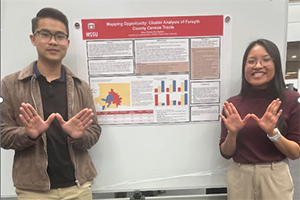
CSEM Faculty and Student Research Fellows present latest research on 2026 Scholarship Day
Professor Bao Maddux, CSEM's newest Faculty Research Scholar from the WSSU Department of Mathematics, is teaming up with CSEM Student Fellow Quoc (Finny) Phi Bui to investigate how social connections in Forsyth County impact upward economic mobility. The county has had long-standing inequities and ten years ago fell near the bottom of national rankings in terms of economic mobility, as first explored by Harvard economist Raj Chetty. The pair are taking Chetty's most recent national research and drilling down to investigate how it affects Forsyth County. They presented their early findings with a poster during WSSU's Scholarship Day on April 9th in the DJR Auditorium, visited by hundreds of students and faculty.
In addition, Ciel Miller, another CSEM student scholar, presented a poster on his early research featuring Black entrepreneurs in Winston-Salem. Miller plans to interview fifteen heads of business, asking them questions about their financial stability, access to capital and origin story. All CSEM Scholars are supported financially through funds provided by The John William Pope Foundation. Miller's research is titled, "Voices of the Hustle: a qualitative survey of Black entrepreneurs in Winston-Salem."
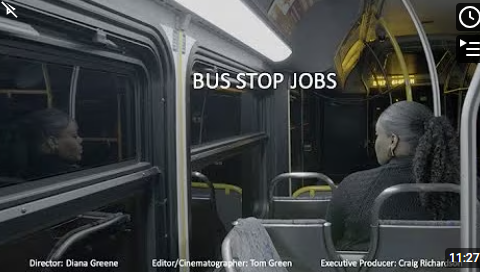
CSEM's short documentary, Bus Stop Jobs credited by City of Winston-Salem with pushing dramatic change in public transit
On April 6th, 2026, Winston-Salem City Council unanimously passed a proposal to reinvent the city bus system, with faster and more frequent buses, better connections between home and work, as well as a microtransit option that picks people up directly from their homes. Numerous officials credited CSEM's research and documentary film on creating guiding themes in their Winston Salem Transit Authority "Vision Proposal." Transportation officials Kelly Garvin and Maddie Burgiss spoke in a recent community meeting of the CSEM film, Bus Stop Jobs as the "North Star" which guided them in thinking about new ways to move people across the city.
In 2017, CSEM produced the short film that highlighted a day in the life of a bus rider, Brittany Marshall, who did her best to navigate work, her son's school and shopping- all without a car. Through the years, it has been seen by thousands both in person and online, and still resonates with viewers today.
The film was referenced in a slideshow presented by transportation officials at community meetings, as the Winston Salem Transit Authority explored a new and creative vision for reinventing the bus system. As CSEM's research directly concluded, the key for the city was to focus on lowering commuting time and improving connections between residences and work. The city listened and responded with quicker routes that do a better job of emulating those peoples' lives with a car.
Jeffrey Fansler, the city's director of transportation wrote to CSEM in an April 1st, 2026 email, "it is truly remarkable how your work has informed policy decisions for our transit system. We thank you for being a resource and consistent positive voice for these bold changes to for WSTA."
Director Craig Richardson recieved mention on public radio WFDD and The Winston-Salem Journal with regard to CSEM's impact on this important city development, and also attended an earlier City Council meeting to give public comments in favor of the change.
Produced and conceived by CSEM Director Craig Richardson, the film was directed by Diana Greene with cinematography by Tom Green. It may be viewed at: https://www.youtube.com/watch?v=scVU9LHmjxQ
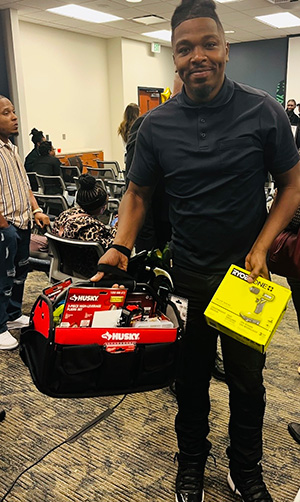
CSEM and Shallow Ford Foundation's new partnership: Bringing Tools to The Do School.
On March 28th, 2026 graduates of Winston-Salem's "The Do School" program met at Piedmont Federal Bank to celebrate the conclusion of a program that resulted in a complete renovation of a once vacant historic home in the city. The Do School has been a long-time partner of CSEM, and formed by Jerry Anderson and local business leaders to give hope to men and women hoping for a new lease on life. The nearly 100 years old home had to be completely gutted by the Do School team, and now is a shining beacon on the block. Other homes on the block are now sprucing up as well, leading to significant ripple effects in the stability of a once declining neighborhood..
Graduates of the Do School are armed with skills, but may not have the resources to purchase tools as they potentially seek lucrative jobs in the construction industry. This is where CSEM and the Shallowford Foundation came in. The two organizations met through a common connection, and realized that they could literally give the tools of economic mobility to the new graduates. CSEM provided $500 per graduate, or $2,000 in total, and the Foundation organized the purchases of hammers, measuring tapes, electric drills and much more. Jerry Anderson, founder of the Do School, gave great thanks to both CSEM and The Shallowford Foundation for setting the graduates on the right path as they enjoy the next chapter of their life.
In May, Prof. Zagros Madjd-Sadjadi will give the CSEM impact report to the Do School board, and continue what has been a long and prosperous partnership with both organizations.
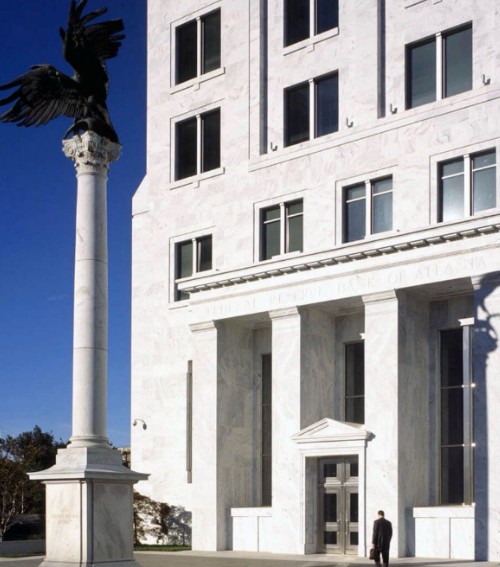
CSEM's research lands an invite to Federal Reserve of Atlanta
On February 12th, CSEM Director Craig Richardson was invited to attend the Federal Reserve of Atlanta for an all-day workshop of 2 dozen top researchers around a discussion on benefits cliffs - federal policies that inadvertently punish people on social assistance by sharply reducing, say a child care benefit, after a raise or promotion. CSEM's work on designing an interactive calculator (shown on CSEM's home page) as well as published research in the highly reputable Journal of Poverty led to the invite. Dr. Richardson's research on "disincentive deserts" (as opposed to benefits cliffs) was cited by other researchers that day, as one of the 3 key studies done nationally on this subject.